


How to Build a Simple Full-Funnel Growth Plan for 2026 (That Actually Gets Executed)
Most businesses don’t have a marketing problem.
They have a planning-to-execution problem.
They have strategies, channel ideas, and KPIs—but no simple system that converts strategy into weekly actions, clear signals, and repeatable results. This is exactly the gap HyperPath solves as a full funnel marketing agency Manchester businesses rely on for execution, not just ideas.
This guide explains how to build a simple full-funnel growth plan for 2026 that’s realistic, easy to execute, and designed to actually move revenue—especially for B2B teams working with a B2B growth agency Manchester companies trust for structured growth.
Why Most Growth Plans Fail (and What “Simple” Really Means)
Most growth plans fail for three predictable reasons:
- They stay abstract
- “Increase awareness” and “improve conversions” aren’t plans—they’re intentions.
- They ignore constraints
- Time, budget, team size, and sales capacity define what’s possible.
- They lack an execution layer
- No sprint cadence, no weekly metrics, no decision rules.
What “Simple” Actually Means
Simple does not mean basic. It means:
- One primary business goal
- A few funnel metrics tied to that goal
- 2–3 channels you can execute consistently
- A 30-day sprint cadence
- Weekly measurement and decisions
This is how strategy turns into calm, focused execution—the same execution-first approach HyperPath applies as a full funnel marketing agency Manchester teams partner with to drive measurable outcomes.
Step 1 — Pick One Business Goal (and One Constraint)
Choose one business goal for the next 90 days.
Examples:
- Increase monthly revenue by £50k
- Generate 30 qualified leads per month
- Book 20 sales calls per month
- Increase ecommerce purchases by 15%
Now choose one constraint:
- Only 6 hours/week available
- No increase in ad spend for 60 days
- Sales can handle only 10 calls/week
- Results needed within 8 weeks
This prevents building plans that only work on paper.
Step 2 — Translate the Goal into Full-Funnel Numbers
A full-funnel plan connects:
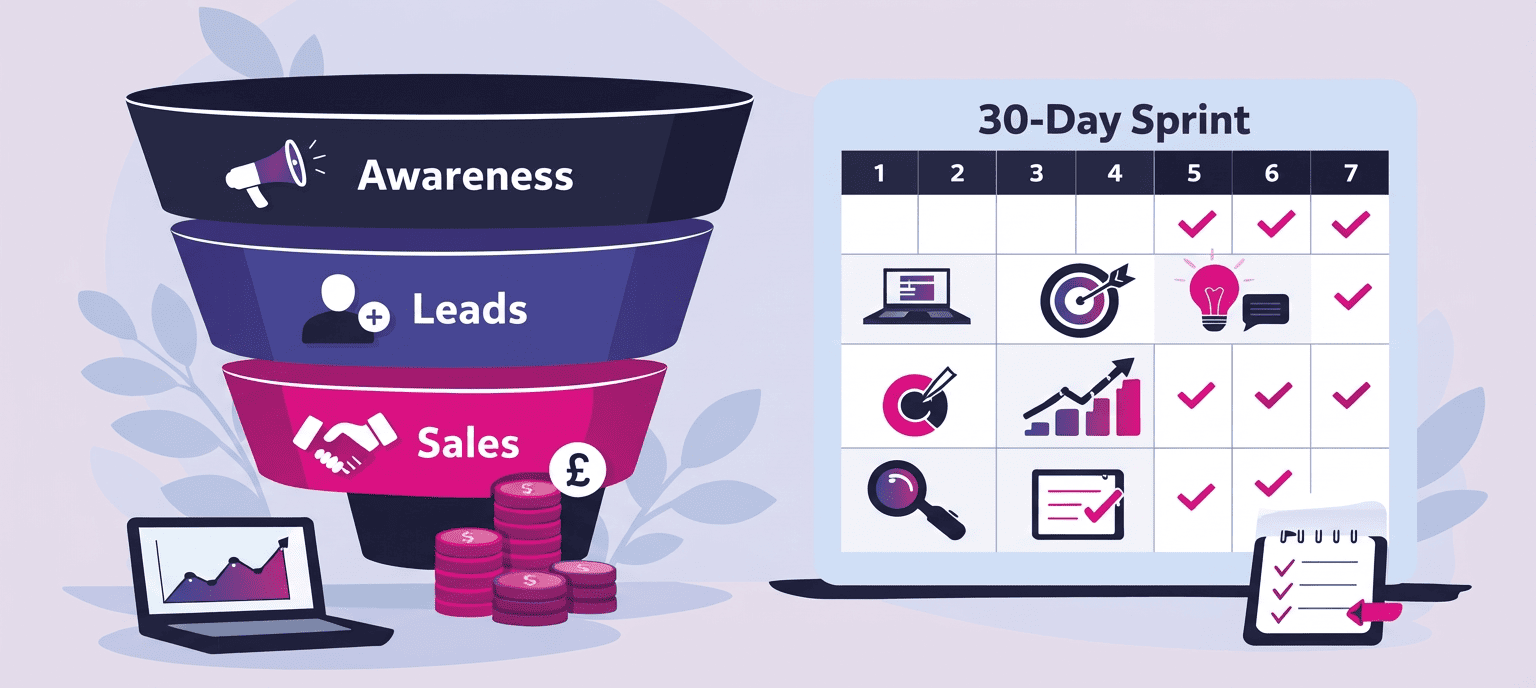
- Awareness → Leads → Sales → Revenue
Work backwards:
- Start with revenue or customers
- Convert that into required leads
- Convert leads into traffic or reach
Awareness Metrics
Choose 1–2 metrics based on how people discover you:
- Website sessions
- Impressions or reach
- Video views
- Branded search growth
Awareness only matters if it feeds the next step.
Lead Metrics
Define what a real lead means for your business:
- Contact form submissions
- Demo or consultation bookings
- Quote requests
- Email sign-ups or downloads
Example target:
“We need 40 qualified leads per month.”
Sales Metrics
Add simple conversion assumptions:
- Lead → sales call
- Sales call → opportunity
- Opportunity → closed deal
- Average deal value
Example math:
- Goal: 10 customers/month
- Close rate: 25%
- Sales calls needed: 40
- Lead-to-call rate: 20%
- Leads needed: 200/month
This creates clarity and removes guesswork.
Step 3 — Choose 2–3 Channels You Can Execute Consistently
Channel strategy isn’t about trends.
It’s about what you can execute every week.
A Simple Channel Framework
- 1 demand-capture channel (SEO, Google Ads)
- 1 demand-creation channel (LinkedIn, content, video)
- (Optional) 1 nurture channel (email, retargeting)
Common combinations:
- SEO + LinkedIn + Email
- Google Ads + CRO + Email
- Meta Ads + Content + Retargeting
If you’re everywhere and nothing works—reduce, don’t add.
Step 4 — Create a 30-Day Sprint Plan (Execution Layer)
This is where the plan becomes real.
Each sprint should define:
- What ships
- Who owns it
- When it goes live
- How success is measured
Week 1 — Build the Offer + Tracking
- Define your core offer (problem, audience, outcome)
- Create or refine one landing page
- Set up GA4 and conversion tracking
- Ensure follow-up exists (email or sales process)
Week 2 — Publish + Launch Distribution
- Publish one core asset (blog, guide, webinar)
- Share 3–5 distribution posts
- Launch 1–2 focused ad campaigns (if paid)
One audience. One promise. One CTA.
Week 3 — Optimise + Follow Up
- Improve headlines, CTAs, page speed
- Reduce form friction
- Speed up lead follow-up (same day minimum)
Most teams stop here—don’t.
Week 4 — Double Down + Document Learnings
- Scale what worked
- Kill what didn’t (data > emotion)
- Document insights for the next sprint
Momentum compounds sprint by sprint.
Step 5 — What to Measure Weekly (Keep / Kill / Improve)
You don’t need complex dashboards—just rhythm.
Weekly Check-In (30 Minutes)
- Inputs
- What shipped this week?
- Funnel signals
- Traffic by channel
- CTR
- Conversion rate
- Cost per lead
- Outcomes
- Leads
- Calls booked
- Opportunities
- Revenue
- Decisions
- Keep
- Kill
- Improve
Weekly clarity reduces stress and improves focus.
Why Full-Funnel Plans Fail Without Feedback Loops
Most teams plan once and hope.
High-performing teams run a loop:
- Strategy → Execution → Measurement → Iteration
This removes opinion-based decisions and replaces them with evidence.
At HyperPath, growth is structured around this loop—clear plans, consistent execution, and continuous optimisation for teams looking to scale with a trusted B2B growth agency Manchester businesses depend on.
Common Objections (and Simple Fixes)
- “We don’t have enough data.”
Start with assumptions. Refine monthly. - “We tried this before.”
Usually too many channels or no sprint discipline. - “We can’t do everything.”
Good. Pick two channels and execute well. - “We hate vanity metrics.”
Then tie every metric to the next funnel step.
Wrap-Up + Next Step
A simple full-funnel growth plan for 2026 doesn’t need complexity.
It needs:
- One clear goal
- Connected funnel metrics
- 2–3 executable channels
- A 30-day sprint system
- Weekly decision-making